Why AI Photo Effects Will Split Into 'Verified' vs 'Underground' by 2027: The FTC's 48-Hour Deepfake Rule That Changes Everything for Soracai Creators
The FTC's 48-hour deepfake rule just triggered a countdown. By 2027, AI creative tools will split into verified platforms and underground alternatives. Here's what that means for you.
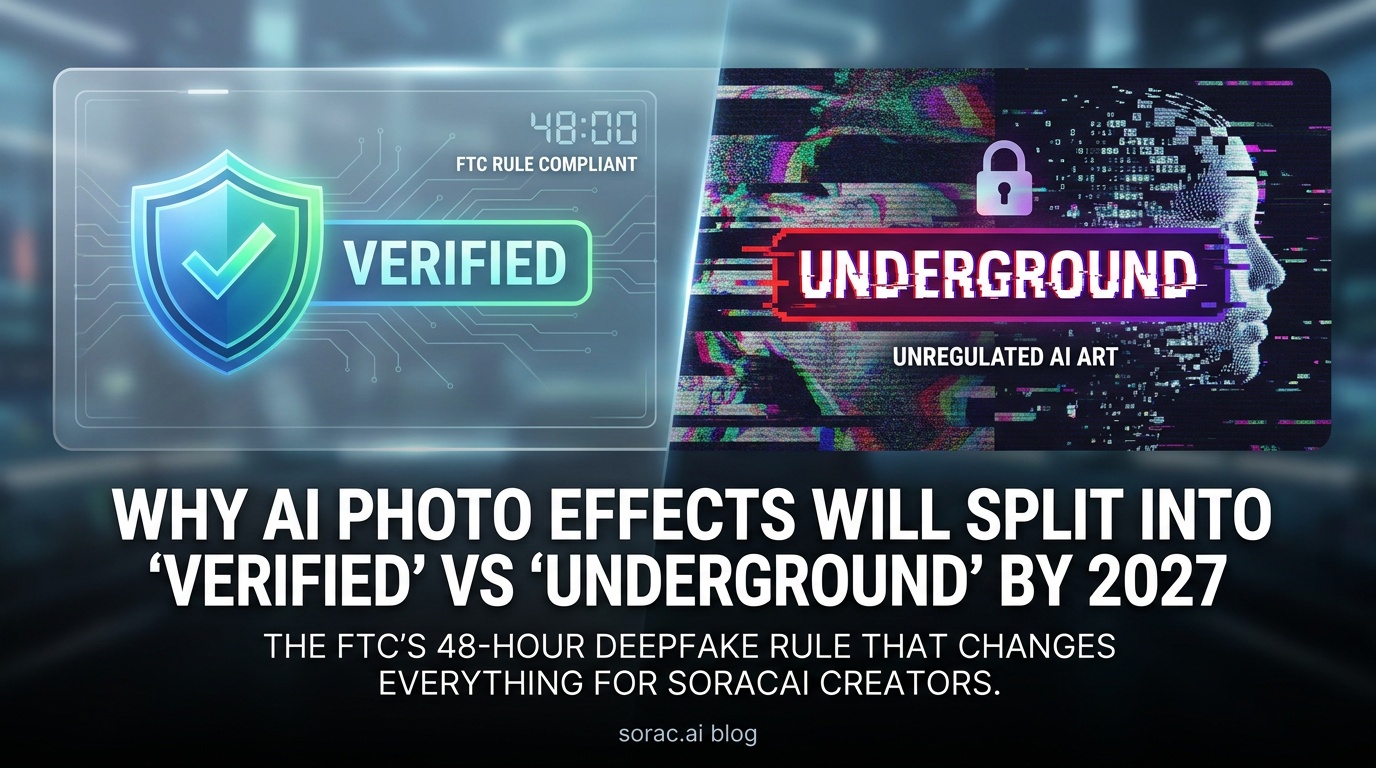
Why AI Photo Effects Will Split Into 'Verified' vs 'Underground' by 2027: The FTC's 48-Hour Deepfake Rule That Changes Everything for Soracai Creators
We're about to watch the AI creative world fork into two distinct universes, and most creators haven't noticed yet.
While everyone's been obsessing over whether Midjourney V8.1's 2K output looks better than Nano Banana 2 Pro (spoiler: it depends on your prompt game), something way more consequential just happened. In May 2026, the FTC dropped the hammer with the TAKE IT DOWN Act, requiring platforms to remove nonconsensual intimate images—including AI deepfakes—within 48 hours of a request.
Seems reasonable, right? Protect people from abuse. But here's what nobody's talking about: this isn't just about removing revenge porn. It's the first domino in a regulatory cascade that will fundamentally reshape how AI photo and video tools operate, what features they can offer, and where creators will go to push boundaries.
By 2027, I'm betting we'll see a clear split between "verified" mainstream AI platforms with heavy moderation and an "underground" ecosystem of tools with zero guardrails. Let me walk you through why this is inevitable—and what it means for anyone using tools like Soracai's AI Dance or Nano Banana 2 Pro right now.
Prediction 1: Major Platforms Will Require ID Verification for Face-Swap Features by Late 2026
The 48-hour takedown rule sounds simple until you realize platforms need to prove they're complying. The easiest way? Know exactly who's creating what.
Expect platforms handling face transformations—like AI Dance videos where you upload a photo and animate it with Kling 2.6 motion control—to start requiring ID verification for certain features. Not for everything, but definitely for anything involving realistic face manipulation.
Timeline: Q4 2026 for major U.S. platforms, rolling out globally through 2027.
Why it's coming: The Supreme Court already declined to hear AI copyright disputes in March 2026, signaling courts won't rush to protect creators. Platforms are on their own for liability, and ID verification is the nuclear option that covers their legal exposure.
What this means for you: If you're building a following around viral effects like the AI Ghostface filter or turning your dog into a breakdancer, archive your best work now. The verification wall is coming, and it'll slow down the spontaneous "let me try this with my friend's photo" viral moments that make TikTok magic happen.
Prediction 2: "Verified Creation" Badges Will Become the New Blue Checkmark
Once platforms know who's creating what, they'll want to advertise it. Enter the "Verified Creation" badge—metadata proving a human uploaded the source material, agreed to terms, and created the output through an approved platform.
Timeline: Mid-2027 for TikTok and Instagram integration.
The evidence: Look at how fast the AI luxury driving effect blew up on TikTok in early May 2026. Multiple tutorials dropped May 2-4 showing creators turning portraits into polished luxury car clips. That trend worked because people trusted the clips were just fun transformations, not identity theft.
As deepfake paranoia grows, platforms will need a trust signal. A little badge saying "This was made with verified tools following platform guidelines" becomes valuable social proof.
Creator impact: Content with verification badges will get algorithmic priority. Unverified AI content will be shadowbanned or require disclaimers. If you're using Soracai's Sora 2 video generator for professional work, expect clients to start asking for proof of verified creation pipelines.
Prediction 3: The "Underground" Will Innovate Faster (and Messier)
Here's where it gets spicy.
For every creator who's fine with ID verification and content moderation, there's another who'll say "screw that" and move to unregulated tools. Not for nefarious reasons necessarily—maybe they're doing political satire, avant-garde art, or just don't want their government knowing they made a dancing pickle video.
Timeline: Already happening. Will become obvious by Q1 2027.
What we're seeing: Google's leaked "Omni" multimodal system (spotted in Gemini UI strings around Google I/O 2026) suggests major players are building unified, controlled creative ecosystems. Meanwhile, open-source alternatives are proliferating with zero guardrails.
The underground will move faster because they're not waiting for legal teams. Expect to see:
The catch: Quality will be inconsistent, costs may be higher (no economy of scale), and you're on your own for legal liability.
Prediction 4: Professional AI Creators Will Need "Compliance Officers" by 2027
If you're making money from AI content—whether that's AI Dance videos for brands, Nano Banana 2 Pro commercial work, or social media management—you'll need someone tracking regulatory compliance.
Timeline: Late 2026 for agencies, mid-2027 for solo pros.
Why: The 48-hour takedown rule is just the beginning. We're about to see:
Midjourney's V8.1 dropped April 30, 2026 with better reference features and personalization. Amazing for creators. Also a legal minefield if you're using celebrity references for commercial work without understanding fair use.
Practical move: If you're serious about AI creative work, start a compliance checklist now. Track:
Prediction 5: "Ethical AI" Will Become a Premium Marketing Feature
Just like "organic" or "fair trade," expect "ethically trained AI" to become a selling point—and a premium price justification.
Timeline: Q2 2027 for mainstream adoption.
The play: Platforms that can prove their models were trained on licensed content, pay royalties to artists, and have robust consent mechanisms will market the hell out of it. Clients will pay more for the peace of mind.
Runway's Gen-4.5 already pitches "cinematic, highly realistic output" with multi-scene consistency and character persistence. The next evolution is "and we can prove every training image was legally sourced."
For Soracai users: Tools like Nano Banana 2 Pro with its 11 aspect ratios and image-to-image features are already offering professional-grade output at 4 coins per generation. As the market splits, transparent pricing and clear ToS become competitive advantages. Know what you're paying for and what rights you're getting.
Prediction 6: Regional AI Tools Will Explode (The "Splinternet" of Creativity)
China has its own AI ecosystem. Europe is building GDPR-compliant alternatives. The U.S. is fragmenting by state. By 2027, where you live will determine which AI tools you can access—and which features they offer.
Timeline: Accelerating now, fully realized by 2028.
Evidence: The FTC's 48-hour rule applies to U.S. platforms. European platforms follow different rules. Asian platforms follow yet another set. Global tools will either geoblock features or create region-specific versions.
Creator strategy: If you're building a brand around AI content, diversify your toolkit. Don't rely on a single platform that might get geoblocked or regulated out of existence in your market. Test Soracai's AI Dance, compare it with Seedance 2.0, understand what Kling 3.0 offers differently. Platform agnostic = future-proof.
Wild Card Prediction: A Major AI Platform Will Get Sued Out of Existence by Q3 2027
Here's my moonshot prediction: a mid-sized AI creative platform with deep pockets but weak legal protections will face a class-action lawsuit over deepfakes, lose catastrophically, and shut down.
Not a tiny startup (no money to sue for) or a giant like Google (infinite legal resources). Something in the middle that became popular fast, cut corners on moderation, and got caught.
Why this matters: The fallout will terrify every other platform. Expect an industry-wide crackdown, with platforms over-correcting and locking down features that were previously open. Archive your creative work now, because access could get restricted overnight.
How to Prepare: Your 2026-2027 AI Creator Survival Guide
1. Document everything: Save your prompts, source images, generation logs. If you need to prove you created something legitimately, metadata is your friend.
2. Diversify platforms: Don't build your entire workflow around one tool. Try Soracai's full suite—AI Dance for viral videos, Nano Banana 2 Pro for images, Sora 2 for text-to-video. Know what each does best.
3. Learn the legal basics: Spend two hours understanding deepfake laws, the TAKE IT DOWN Act, and platform ToS. Boring? Yes. Worth it when you avoid a $10k lawsuit? Also yes.
4. Build on verified platforms for professional work: If you're getting paid, use tools with clear legal protections and compliance features. Save the experimental underground tools for personal projects.
5. Create your ethical guidelines: Decide now what you will and won't create. Don't wait until you're offered $500 to make something legally gray. Know your boundaries.
6. Join creator communities: The regulatory landscape is changing monthly. Follow AI creators on Twitter/X, join Discord servers, read platforms like this. Shared knowledge = competitive advantage.
The Bottom Line: Choose Your Side, But Choose Wisely
The split is coming whether we like it or not. By 2027, you'll be creating in either the verified ecosystem with its safety rails and legal protections, or the underground with its innovation and risk.
Most of us will straddle both—Soracai's AI Dance for client work that needs to be platform-friendly, something else for weird experimental art at 2am.
The key is understanding what you're using, why, and what the tradeoffs are. The Wild West era of AI creative tools isn't ending—it's just getting zoning laws.
Start preparing now, because by the time everyone else notices the fork, the best spots in both worlds will already be taken.