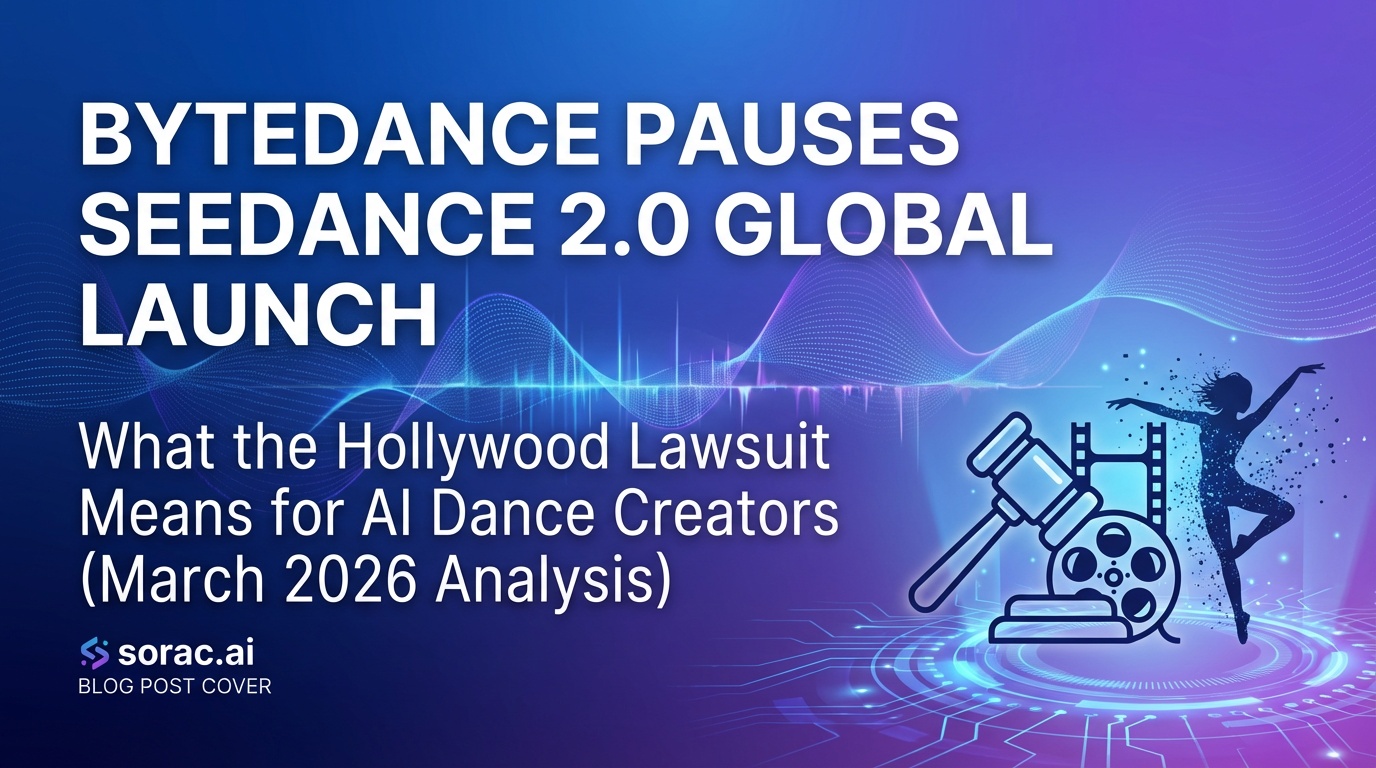
ByteDance Pauses Seedance 2.0 Global Launch: What the Hollywood Lawsuit Means for AI Dance Creators (March 2026 Analysis)
ByteDance just paused Seedance 2.0's global launch after Hollywood sent cease-and-desist letters. Here's what the legal battle means for every AI video creator in 2026.
The News: ByteDance Hits the Brakes on Seedance 2.0
On March 15, 2026, ByteDance pulled the emergency brake on Seedance 2.0's global rollout—just days before the planned mid-March launch. The reason? A stack of cease-and-desist letters from Hollywood's heaviest hitters: Disney, Warner Bros., and several other major studios.
The trigger? Viral clips that went absolutely nuclear on TikTok, including an AI-generated showdown between Tom Cruise and Brad Pitt that racked up millions of views before anyone could say "intellectual property infringement." Now engineers and lawyers are huddled in conference rooms, trying to figure out how to launch a revolutionary AI video tool without getting sued into oblivion.
For creators who've been salivating over Seedance 2.0's multimodal capabilities—especially that "@ reference" system that lets you upload dance videos and clone choreography—this is a massive buzzkill. But it's also a fascinating case study in how AI innovation is colliding head-first with century-old copyright law.
Background: How We Got Here
The Seedance 2.0 Promise
Seedance 2.0 wasn't just another AI dance generator. ByteDance was positioning it as a complete multimodal video creation platform. The killer feature? An "@ reference" system that could ingest:
Think of it as the Swiss Army knife of AI video—everything creators needed to pump out viral content at scale. The platform promised to democratize video creation in ways that would make traditional VFX studios sweat.
The Viral Clips That Started the Fire
The Tom Cruise vs. Brad Pitt video wasn't just popular—it was scarily good. AI-generated versions of both actors, mid-90s vintage, going head-to-head in a dance battle that looked like it was ripped from a deleted scene of "Fight Club: The Musical."
Hollywood studios noticed. And they did not find it amusing.
Other problematic clips included:
Analysis: Why This Matters More Than You Think
It's Not Just About One Platform
The Seedance 2.0 pause isn't an isolated incident—it's a canary in the coal mine for the entire AI video generation industry. Here's why this matters:
1. The Training Data Problem
AI models like Seedance 2.0, Kling 3.0, and others are trained on massive datasets of existing videos. Where did that training data come from? Probably YouTube, movies, TV shows, and other copyrighted content. Studios are now asking: "Did you ask permission to train your AI on our billion-dollar franchises?"
Spoiler alert: They probably didn't.
2. The Output Problem
Even if training on copyrighted data gets a legal pass under fair use (a BIG if), what about the output? When AI generates a video of Tom Cruise, whose rights are being violated? Tom Cruise's publicity rights? Paramount's IP rights? Both?
The law hasn't caught up, and ByteDance just became the test case nobody wanted to be.
3. The Scale Problem
Traditional copyright infringement happens one video at a time. AI tools can generate thousands of potentially infringing videos per day. How do you even enforce copyright at that scale? DMCA takedowns were designed for the YouTube era, not the AI-generated-everything era.
What Hollywood Really Fears
Let's be real: Disney isn't scared of one viral TikTok. They're terrified of a future where:
As one anonymous studio executive told TechCrunch: "We spent $200 million making that movie. They spent $0 training their AI on it. That's not fair use—that's theft with extra steps."
Impact on Creators and the Industry
For Global Creators: The Workaround Scramble
Seedance 2.0 is still available in China, leading to a predictable gold rush:
But relying on VPNs and workarounds isn't sustainable for professional creators who need reliable tools.
The Alternative Tools Surge
While ByteDance sorts out its legal mess, competing platforms are having a moment:
Kling 2.6 and 3.0 remain available globally, though they're likely watching the ByteDance situation nervously. Kling's motion control technology powers platforms like Soracai's AI Dance feature at soracai.com/ai-dance, which lets you transform photos into dancing videos using 23+ dance styles—from hip-hop to ballet to that viral Robot dance everyone's obsessed with.
The key difference? Kling-based tools tend to work with user-uploaded photos rather than celebrity likenesses, sidestepping some (but not all) of the IP issues.
Runway Gen-4.5 is positioning itself as the "professional, licensed" option, though at a significantly higher price point.
DIY Solutions are getting more sophisticated. Creators are combining multiple tools—using AI image generators like Nano Banana Pro for custom character creation, then animating those original characters with dance tools. It's more work, but you own the IP.
The Film Industry Pivot
March 13 reporting showed that AI video generators are already slashing VFX budgets by generating backgrounds, crowd scenes, and physics simulations. Studios are in a weird position: they want to use AI tools to cut costs, but they also want to prevent others from using AI to compete with them.
This contradiction is going to shape the next decade of entertainment.
The Viral Dancing Babies Phenomenon
Ironically, while Seedance 2.0 sits in legal limbo, the AI dancing babies trend is absolutely exploding. From March 7-11, TikTok and YouTube were flooded with AI-generated infant dancers performing viral challenges to amapiano and afrobeat tracks.
Why is this trend thriving while Seedance struggles?
This is the blueprint for sustainable AI content creation: use the technology, but create original IP. You can try this yourself at Soracai's AI Dance page—upload a photo (yours, not Tom Cruise's), pick from 23+ dance templates like "Dance Baby" or "Shake It To Max," and get your video in 2-5 minutes for just 8 coins.
What to Watch For Next
Short Term (Next 3-6 Months)
Legal Precedents: The ByteDance case will likely result in either a settlement or a landmark court decision. Either outcome will set the rules for every AI video company.
Industry Standards: Expect major AI companies to form a consortium and propose self-regulation before governments impose harsher restrictions.
Licensing Deals: Studios might start licensing their IP for AI training—for a hefty fee. This could create a two-tier system: expensive "licensed" AI tools and cheaper "use at your own risk" alternatives.
Long Term (6-24 Months)
Legislation: The EU, US, and China will all pass AI-specific copyright laws. They won't agree with each other, creating a fragmented global landscape.
Technical Solutions: Watermarking, content authentication, and AI-detection tools will become standard. Blockchain-based rights management might finally find a real use case.
New Business Models: Platforms like Soracai that use coin-based systems rather than subscriptions might have an advantage—it's easier to price individual features based on their legal risk profile.
Practical Takeaways for Creators Right Now
1. Create Original IP
The safest path forward: generate your own characters with AI image tools, then animate them. Use Nano Banana Pro to create detailed, original characters with the PRO mode for enhanced quality, then bring them to life with AI dance or video tools.
2. Understand Fair Use (But Don't Rely On It)
Parody and commentary have legal protections, but "I thought it was funny" isn't a legal defense. If you're using celebrity likenesses or copyrighted characters, understand you're in a gray area that's rapidly turning black.
3. Diversify Your Tools
Don't build your content strategy around a single platform that might get sued into oblivion. Learn multiple tools. Soracai offers a full suite—AI image generation, dance videos with Kling 2.6, Sora 2 video generation, and trending effects—all with a simple coin system. If one feature faces restrictions, you have alternatives.
4. Document Your Process
If you do face a copyright claim, being able to prove you used original source material helps. Keep records of your prompts, source images, and creative process.
5. Stay Informed
The AI video landscape is changing weekly. The Seedance 2.0 pause happened with 72 hours notice. Follow AI news closely and be ready to pivot.
The Bigger Picture
The ByteDance Seedance 2.0 pause is a watershed moment. For years, AI companies operated in a legal gray zone, moving fast and breaking things (including copyright law). Hollywood's cease-and-desist letters signal that the grace period is over.
But here's the thing: the technology isn't going back in the bottle. AI video generation works. It's transformative. And millions of creators want access to it.
The next few months will determine whether AI video becomes a legitimate creative tool with clear legal boundaries, or an underground technology that only pirates and VPN users can access.
For creators, the message is clear: the wild west era of AI video is ending. The ones who'll thrive are those who learn to work within the emerging rules—or better yet, create content so original that the rules don't apply.
Want to experiment with AI dance videos while staying on the right side of copyright? Try Soracai's AI Dance feature with your own photos. No celebrity deepfakes, no legal headaches—just pure creative fun with cutting-edge Kling 2.6 motion control technology.
The revolution will be AI-generated. But it might also be properly licensed.