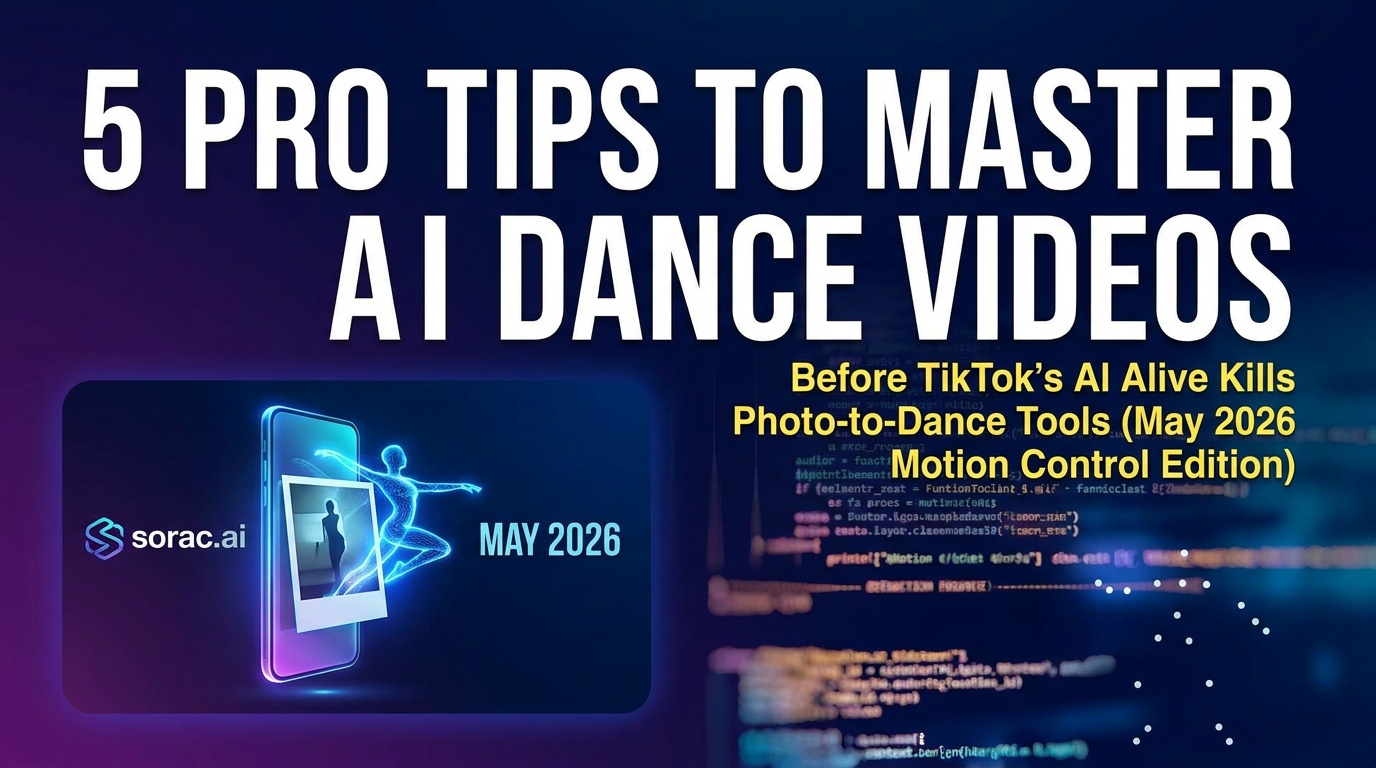
5 Pro Tips to Master AI Dance Videos Before TikTok's AI Alive Kills Photo-to-Dance Tools (May 2026 Motion Control Edition)
TikTok's AI Alive just launched—here's how to master motion control AI dance videos before the platform eats third-party tools alive. Kling 2.6 secrets inside.
5 Pro Tips to Master AI Dance Videos Before TikTok's AI Alive Kills Photo-to-Dance Tools (May 2026 Motion Control Edition)
TikTok just dropped AI Alive last week—their first native image-to-video feature that lets you animate photos directly inside Story Camera. If you've been sleeping on AI dance generators, this is your wake-up call. The platform is eating the third-party tool market alive, and if you don't nail motion control now, you'll be fighting TikTok's own algorithm and their built-in creator tools.
Here's the thing: standalone AI dance platforms like Soracai's AI Dance still crush TikTok's basic animation features because they use Kling 2.6 motion control—the same tech that made Seedance 2.0 go so viral in China that Disney sent cease-and-desist letters in March. That's the power you want. But only if you know how to use it.
Let's get into the five moves that separate viral dance videos from the cringe compilations nobody shares.
1. Choose Your Source Photo Like Your Viral Life Depends On It (Because It Does)
Use high-resolution, well-lit photos with clear body positioning. Motion control AI needs to see where limbs begin and end. Blurry selfies with half your face cut off? The algorithm will hallucinate joints in weird places and your "dance" will look like a glitching NPC.
Face the camera straight-on or at a slight angle, never in profile. Kling 2.6's skeletal estimation (the same tech behind LDH and SoftBank's upcoming AI DANCE LAB app launching May 2026) works best when it can map both shoulders, hips, and knees in one frame. Side profiles confuse the bone structure detection.
Pro Tip: If you're uploading a baby photo or pet pic for that viral "dancing baby" trend, make sure the subject takes up at least 60% of the frame. Too much background = the AI wastes processing power figuring out what not to animate.
2. Match Your Dance Style to Your Photo's Energy (Don't Make Grandma Breakdance)
This sounds obvious, but I see it butchered daily. Pick a dance template that matches your subject's vibe and physical position. A seated portrait should get a smooth upper-body groove (try Robot or Rockstar on Soracai's 23+ dance styles), not a full-body salsa that requires legs the photo doesn't show.
For standing full-body shots, go aggressive: Hip-hop, breakdancing, or the Shake It To Max template. These styles use big motion vectors that read clearly even on a phone screen.
For close-up portraits or babies, stick to gentle motion: Waltz, tango, or the Dance Baby template. Excessive motion on a tight crop creates nauseating camera shake.
Pro Tip: The Chanel and Jennie templates are optimized for vertical 9:16 TikTok/Reels framing. If you're shooting for YouTube Shorts, test your video in portrait before you burn 8 coins on generation.
3. Nail Your Prompt Game When You Need Custom Motion (Text-to-Video Hybrid Strategy)
Most people don't know this: you can stack AI dance with text-to-video for hybrid control. Here's the workflow:
Step 1: Generate your base dance video using AI Dance motion control (8 coins, 2-5 minutes).
Step 2: If the background is boring or you want environmental effects, feed that video into a text-to-video tool like Sora 2 on Soracai with a prompt like "neon cityscape background, rain effects, cinematic lighting."
Why this works: Motion control handles the hard part (realistic body movement). Text-to-video handles the easy part (pretty backgrounds and atmospheric effects). TikTok's AI Alive tries to do both at once and ends up mediocre at everything.
Pro Tip: Use Sora 2's 10-frame option (5 coins) for quick tests. Only go 15 frames when you're sure the motion is perfect—longer videos cost more and TikTok's algorithm doesn't reward length, it rewards completion rate.
4. Optimize for Platform Before You Export (Aspect Ratios Are Not Optional)
I cannot stress this enough: wrong aspect ratio = dead video. TikTok and Reels are 9:16 (portrait). YouTube and presentations are 16:9 (landscape). If you upload landscape to TikTok, you lose 40% of screen real estate to black bars and your video gets 10x less reach.
Here's the cheat sheet:
Before you generate, check your source photo orientation. If it's horizontal, either crop it to vertical in Nano Banana 2 Pro's image editor first (1 coin standard, 4 coins PRO mode for better quality), or accept you're making YouTube content.
Pro Tip: If you're making a meme account, generate the same dance in both 9:16 and 16:9, then post the portrait version to TikTok and the landscape version to YouTube Shorts as a cross-post. Different audiences, same content, double the reach.
5. Ride Viral Formats Before They Peak (Timing Beats Perfection)
The AI dance trend cycle moves fast. Remember when everyone was doing the AI Homeless Man transformation in March? That window lasted like 11 days before it got cringe. Right now (May 2026), here's what's still working:
Dancing baby + swing-dance style: Still performs because it's wholesome and shareable. Parents eat this up. Use the Dance Baby template on Soracai.
Pet dance videos: Dogs and cats doing hip-hop. Evergreen content that algorithms love because watch-time is insane.
"Add Girlfriend/Boyfriend" + dance duet: Combine AI-generated partner photos from Trends with a couples' dance style. Lonely people share this religiously.
Action Figure dancing: Use the Action Figure Creator effect to turn yourself into a toy, then animate it dancing. Meta-humor = engagement.
Pro Tip: The Ghostface effect is losing steam but still works if you pair it with a creepy slow-motion dance (waltz or tango). Don't just copy the trend—add a twist that makes it yours.
Bonus: Why Kling 2.6 Motion Control Still Beats TikTok's AI Alive
TikTok's AI Alive launched this week with multi-step moderation, C2PA metadata, and AI labels—which is great for transparency but terrible for creative flexibility. Every video gets watermarked and flagged as AI-generated, which some audiences scroll past automatically.
Kling 2.6 (the engine behind Seedance 2.0 and Soracai's AI Dance) gives you:
Yes, ByteDance paused Seedance's broader launch after Disney's copyright threats, but the tech is still everywhere in white-label tools. Use it while the legal dust settles.
The Reality Check Nobody Wants to Hear
AI dance videos are not a "set it and forget it" strategy. TikTok's algorithm in May 2026 is viciously good at detecting low-effort AI slop. If you're just batch-generating 50 dancing baby videos with zero editing, you'll get suppressed.
The creators winning right now are using AI dance as the base layer, then adding:
AI is the tool. You're still the creator. Act like it.
Your Move
TikTok's AI Alive is coming for the third-party tool market, but right now—May 2026—you still have a 6-12 month window where dedicated motion control platforms like Soracai's AI Dance produce noticeably better output. Use it.
Grab a high-res photo, pick a dance style that matches the energy, optimize for 9:16, and ship it before the trend dies. The algorithm rewards speed over perfection, and the next viral format is already being tested in someone's drafts folder.
Don't be the person who masters AI dance videos in 2027 when everyone's moved on to AI hologram concerts or whatever dystopian nonsense comes next.