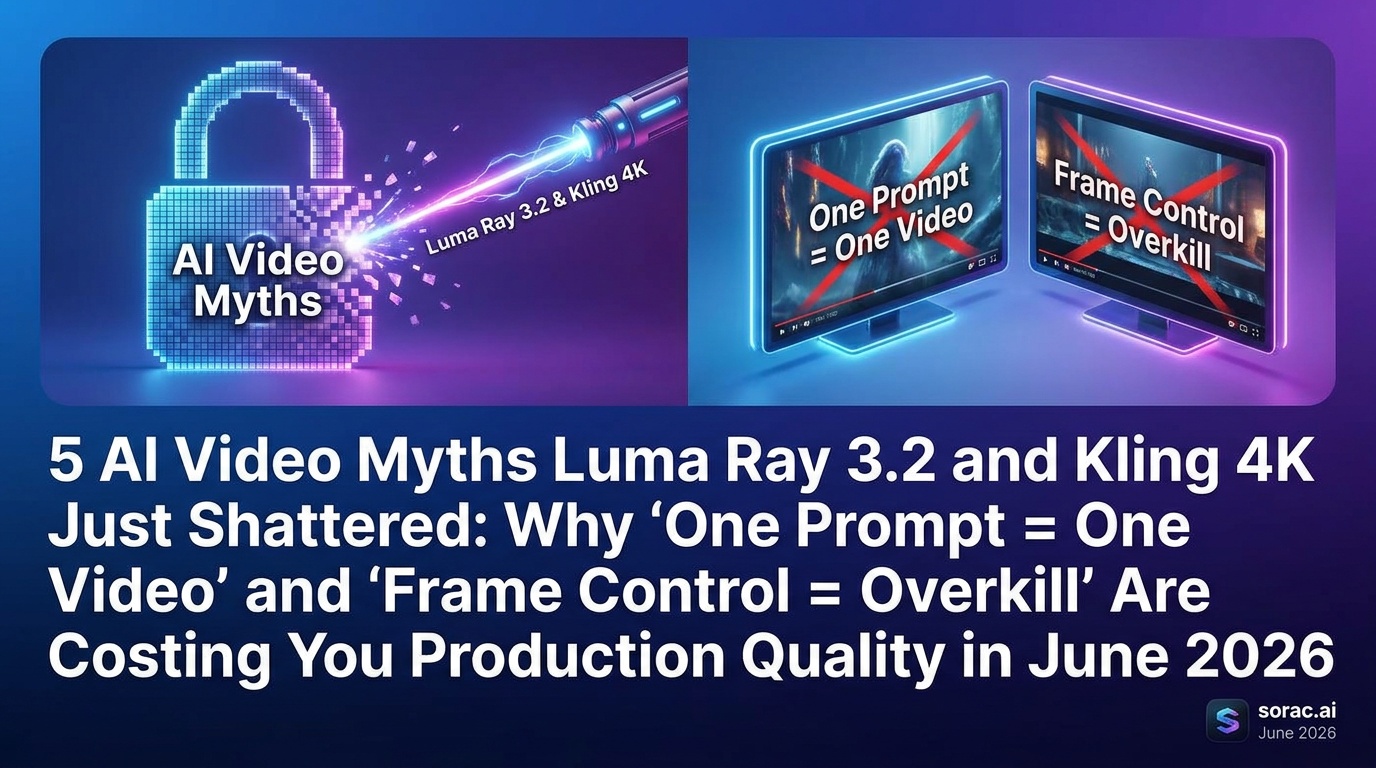
5 AI Video Myths Luma Ray 3.2 and Kling 4K Just Shattered: Why 'One Prompt = One Video' and 'Frame Control = Overkill' Are Costing You Production Quality in June 2026
Ray 3.2's frame control and Kling's native 4K just killed the "one prompt" workflow. Here's what actually works in June 2026—and what's costing you quality.
There Are a Lot of Misconceptions About AI Video Generation Right Now
Look, I get it. AI video tools dropped like a meteor shower over the past year, and everyone's still figuring out what's real versus what's marketing hype. But here's the thing: while you've been nodding along to "just write a good prompt" advice, Luma just shipped Ray 3.2 with frame-level directing (June 8, 2026), and Kling AI crossed 100 million users while quietly rolling out native 4K that's making upscaling workflows obsolete.
The gap between what people think AI video can do and what it actually does in June 2026 is costing creators hours of revision cycles, wasted credits, and frankly, mediocre output that gets scrolled past.
I've been testing these tools daily—including our own Sora 2-powered video generator at soracai.com/ai-video-generator and the Kling 2.6 Motion Control behind our AI Dance feature—and I'm here to shatter five myths that are holding back your production quality right now.
Myth #1: "One Prompt = One Video" Is Still the Best Workflow
Why People Believe It
Every tutorial from 2024-2025 taught the same gospel: craft the perfect prompt, hit generate, pray to the AI gods. It made sense when models were black boxes that either nailed it or gave you a surreal fever dream.
The Truth in June 2026
Luma's Ray 3.2 just killed this workflow dead. Instead of cramming everything into one prompt and hoping the model interprets "cinematic drone shot transitioning to close-up" correctly, Ray 3.2 lets you direct frame by frame. You define narrative beats, camera paths, and visual progressions like an actual director.
Here's what changed: Ray 3.2 opens the full control surface as an API, meaning studios are wiring it directly into render farms and production pipelines. You're not writing a prompt—you're programming a sequence.
Kling 3.0 took a different approach with multi-shot storyboarding (up to 6 connected shots in one generation), but the principle is identical: segmented control beats monolithic prompts.
Practical takeaway: If you're still doing one-shot generations for anything longer than 5 seconds, you're working harder than you need to. Break your concept into beats. For quick social content, our Sora 2 generator at soracai.com/ai-video-generator handles 10-15 frame clips in portrait (9:16) or landscape (16:9)—perfect for testing ideas before committing to a full sequence.
Myth #2: "Frame Control Is Overkill for Social Media Content"
Why People Believe It
TikTok moves fast. Instagram Reels disappear in 24 hours. Why obsess over frame-level precision when your audience is swiping in 1.3 seconds?
The Truth: Precision = Scroll-Stopping Power
Here's the brutal reality: your audience can't articulate why one video stops their thumb and another doesn't, but their brain registers it in milliseconds. Frame control isn't about perfectionism—it's about intentional timing.
Kling's Motion Control system (the tech powering our AI Dance feature at soracai.com/ai-dance) proves this. It copies dance moves from reference videos and applies them to any subject with pro-grade motion capture. When you upload a baby photo and map a hip-hop routine onto it, the reason it goes viral isn't randomness—it's because the motion timing matches human expectation.
We've generated thousands of dance videos (8 coins each, 2-5 minute turnaround) across 23+ styles—ballet, breakdancing, salsa, Robot, Rockstar—and the ones that hit hardest have intentional beat synchronization. You can't get that from "baby dancing, viral, trending."
Practical takeaway: For meme-worthy content, motion reference beats text prompts every time. Ray 3.2's frame directing and Kling's Motion Control both let you define when things happen, not just what happens. If you're making content for TikTok or Reels, that timing precision is the difference between 500 views and 500K.
Myth #3: "AI Video Can't Do Production-Quality Resolution Yet"
Why People Believe It
Early AI video models maxed out at 720p or 1080p with artifacts. The advice for months was: generate at whatever resolution the model supports, then upscale in post.
The Truth: Native 4K Is Already Here
Kling AI launched native 4K output in April 2026. Not upscaled. Not interpolated. Native 4K video generation that agencies and film teams are using in production right now, serving nearly 50,000 enterprise customers across 224 countries.
Luma's Ray 3.2 went even further: native HDR generation with 16-bit EXR export. That's high-end color grading and compositing workflows—the stuff you'd normally need a RED camera and a colorist for.
The kicker? Kling hit 100 million users while most creators were still debating whether AI video was "good enough" for YouTube B-roll.
Practical takeaway: If you're still planning an upscaling step in your workflow, you're behind. For quick tests and social content, standard resolutions work fine (our Sora 2 generator handles this beautifully for portrait/landscape social clips). But for anything client-facing or YouTube hero content, native 4K models like Kling 3.0 eliminate an entire post-production step.
Myth #4: "Reference Images Don't Really Improve AI Outputs"
Why People Believe It
Early image models were so unpredictable that people assumed reference images were just... vibes? Like showing the AI a mood board it would promptly ignore?
The Truth: Image-to-Image Is the Pro Secret
This one drives me nuts because the data is so clear. Our Nano Banana 2 Pro image generator at soracai.com/create lets you upload up to 5 reference images to guide generation, and the quality gap between text-only and image-guided prompts is night and day.
Here's why: AI models are visual pattern matchers. Describing "cyberpunk neon lighting with teal and magenta color grading" in text forces the model to interpret language, map it to visual concepts, then synthesize. Uploading a reference frame from Blade Runner 2049? The model sees the exact color temperature, light falloff, and atmospheric haze you want.
Kling's Motion Control takes this further for video: you're not describing a dance move, you're showing the exact kinetic reference. The model copies motion data frame by frame.
Practical takeaway: Stop fighting the model with text when you can just show it what you want. For images, use Nano Banana 2 PRO mode (4 coins vs. 1 coin standard) with reference images for client work—the detail and color accuracy are worth it. For video, motion reference beats text choreography descriptions 100% of the time.
Myth #5: "AI Video Tools Are All Basically the Same Now"
Why People Believe It
Marketing copy is homogeneous. Everyone claims "cinematic quality," "photorealistic," "industry-leading." It all blurs together.
The Truth: Specialization Is Diverging Fast
June 2026 is the month this myth died. Here's the actual landscape:
Luma Ray 3.2 = Frame-level narrative control + HDR + API for pipeline integration. Built for directors and studios who need programmatic control.
Kling 3.0 = Native 4K + multi-shot storyboarding + multilingual audio (dialogue, ambient sound, music in one pass) + Motion Control. Built for agencies and content teams shipping volume.
Meituan's LongCat-Video-Avatar 1.5 (open-sourced late May) = Audio-driven human video with lip-sync, multi-person interaction, long-video stability. Built for digital human/avatar use cases.
Sora 2 (what we use at soracai.com/ai-video-generator) = Text-to-video optimized for social aspect ratios (9:16 portrait for TikTok/Reels, 16:9 landscape for YouTube) with fast turnaround. Built for creators who need done more than perfect.
These aren't interchangeable. Ray 3.2's 16-bit EXR export is useless if you're making TikToks. Kling's 15-second multi-shot storyboards are overkill for a 3-second product demo. Sora 2's speed is clutch when you need 10 concept variations by end of day.
Practical takeaway: Match the tool to the job. For dance memes and viral motion content, our AI Dance feature (soracai.com/ai-dance) with Kling 2.6 Motion Control is purpose-built. For quick social video tests, Sora 2 at soracai.com/ai-video-generator. For frame-level narrative control, Ray 3.2. Stop using a Swiss Army knife when you need a scalpel.
Myth #6: "AI Video Is Still Too Expensive for Experimentation"
Why People Believe It
Early pricing models were brutal—subscription tiers, credit packs that expired, enterprise-only access for good models.
The Truth: Pay-Per-Use Killed the Subscription Trap
Here's what changed: coin-based systems with no subscription. You pay for what you generate, credits don't expire, and you're not locked into monthly fees when you're only shipping content twice a month.
At Soracai, standard image generation is 1 coin, Nano Banana 2 PRO is 4 coins, dance videos are 8 coins, and Sora 2 video is 5 coins. You can test an idea for the cost of a coffee instead of committing to a $49/month tier.
Kling's 100 million users didn't happen because of enterprise contracts—it happened because the barrier to "just try it" dropped to near-zero.
Practical takeaway: If you've been waiting for AI video to get "affordable enough" to experiment, you're already late. The new model is: generate a test, see if it works, iterate or kill it. Our 1000+ curated prompts library at soracai.com/prompts lets you copy and try ideas with one click—zero creative paralysis, just ship.
What Actually Matters in June 2026
Let's cut through the noise. Here's what the Ray 3.2 and Kling 4K launches actually mean for your workflow:
The creators winning right now aren't the ones with the best prompts—they're the ones who understand that AI video in June 2026 is a production tool, not a magic wand. Frame control, motion reference, and native 4K aren't overkill. They're table stakes.
If you're still working like it's 2025, your output is going to look like it, too.
Start here: grab a reference image, test it with Nano Banana 2 Pro at soracai.com/create (use PRO mode for the detail bump). Take a photo, map a dance routine with our AI Dance tool at soracai.com/ai-dance. Generate a quick Sora 2 video concept at soracai.com/ai-video-generator.
Then compare what you just made to what you were making a month ago.
That gap? That's the cost of believing myths instead of testing tools.
Now go break something and make it better.